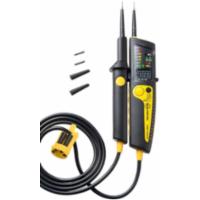
- Max. voltage: 690 V
- Min. voltage: 12 V
Voltage testers for electrical installation work
A voltage tester proves whether a circuit is live before work starts, and the two-pole instrument is the reference for that check because it loads the circuit instead of reacting to stray fields. Bridge both conductors and the lamp scale or display shows presence and rough magnitude, so an induced voltage on a disconnected line is not mistaken for a live supply.
Match the rating to the installation. Instruments specified to 1000V AC in CAT IV cover distribution boards and service entries, while lower categories are limited to socket outlets and the circuits downstream of them. A switchable load helps clear capacitive coupling on long parallel cable runs, and a continuity range on the same probes saves reaching for a second instrument during fault finding on lighting and control wiring.
Also weigh probe guarding, lead length and whether the continuity range needs batteries. Dimensional and levelling checks sit elsewhere in analogue measuring instruments, alongside the micrometer.
- Max. voltage: 690 V
- Min. voltage: 12 V
- Max. voltage: 1000 V
- Min. voltage: 0,5 V
- Max. voltage: 1000 V
- Min. voltage: 12 V
- Max. voltage: 1000 V
- Min. voltage: 12 V
- Max. voltage: 600 V
- Supplier warranty: FACOM - 3 years
- Min. voltage: 12 V
- Max. voltage: 400 V
- Min. voltage: 0 V
- Product Range: Stanley Fatmax
- Max. voltage: 1000 V
- Min. voltage: 12 V
- Max. voltage: 48 V
- Min. voltage: 3 V
- Max. voltage: 400 V
- Min. voltage: 6 V
- Max. voltage: 400 V
- Min. voltage: 12 V
- Max. voltage: 1000 V
- Min. voltage: 12 V
- Supplier warranty: FACOM - 2 years
- Max. voltage: 1000 V
- Min. voltage: 12 V
- Max. voltage: 400 V
- Min. voltage: 6 V