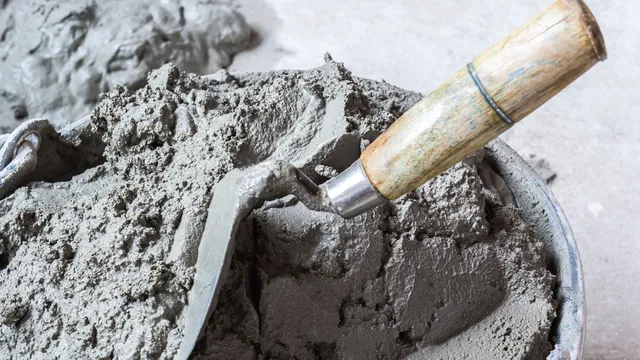
What type of cement do I need for which job? After all, not all types of cement are the same. Cement can be used for a variety of construction works and that is why there are different types of cement on the market. Picking a random bag of cement from the shelves at a DIY store is therefore not a good idea and you probably will have picked the wrong kind.
There is quite a bit of choice in the different types of cement, but how do you know which type of cement to use? Below we would like to explain which types of cement exist and for which jobs which cement can best be used.
What exactly is cement?
Cement is a finely ground binder, consisting mainly of calcium hydrogen silicate, which together with water hardens to a stony material, both in the open air and in water. So what is the difference between cement, concrete and mortar? The basic difference is that cement is a fine binding powder (never used alone), mortar is composed of cement and sand, and concrete is composed of cement, sand, and gravel.
How to mix cement?

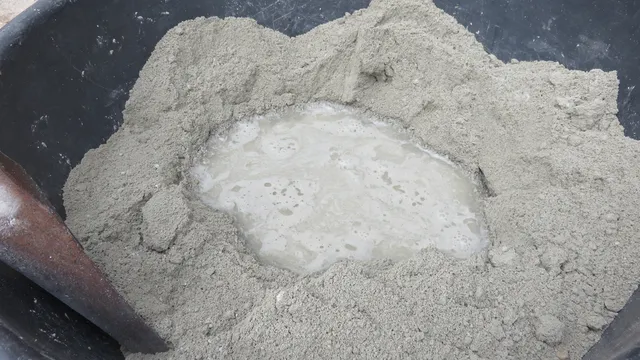
First, mix the sand and gravel in a grout tub or something else to mix in the cement, until well mixed. Always use work gloves to protect hands. Then add the cement until you get an even consistency. Now add the water little by little to obtain a homogeneous mass without lumps. You can use a concrete mixer to mix the cement. A concrete mixer is a device with a mixer attached, specifically suitable for mixing cement.
Different cement strengths
The strength development of cement is not only determined by the composition but also by the grinding fineness, classified in classes 32.5, 42.5 and 52.5. This classification according to strength is based on a pressure test after 28 days. Strength class 32.5 is used for applications where a high initial strength is not required. Strength class 42.5 must be used in case the required compressive strength must exceed 30N / mm2 after 28 days. Strength class 52.5 is suitable for applications where a high initial strength is required.
Types of cement and when to use
There are different types of cement that can be used for different purposes. There is a wide choice of different types of cement and we are happy to explain the differences.
Portland cement
Portland cement is the most commonly used type of cement and can actually be used for any job. Portland cement is used, among other things, for concrete for foundations. Portland cement is a strong binder. After this type of cement comes into contact with water, it forms a kind of paste after which it hardens fairly quickly. Portland cement is also often used in the production of precast concrete and only then brought to the site like tiles. Portland cement is also used in ready-mixed concrete.
Portland composite cement
Portland composite cement is used for the preparation of concrete mortar as well as masonry and grout. This type of cement has a gray color and only has a strength class of 32.5. Portland composite cement is known for having a long working time and a quiet strength build-up.
Natural cement

Natural cement consists of lime and marl and is made in the same way as Portland cement. Mixed with sand and water, this lime can be used as a masonry. The applications of natural cement depend on the specific composition of the natural cement. Natural cement is often used as an additive to natural hydraulic lime to accelerate curing, increase compressive strength, improve erosion, salt and frost resistance, reduce shrinkage and reduce permeability.
Blast furnace cement
Blast furnace cement makes use of blast furnace granulate, the remainder of the reaction between coal and ore in a blast furnace. This type of cement is used for structures intended for flood defense and in places prone to chloride and sulphate attack. Blast furnace cement usually reacts slower than Portland cement and reacts faster at very high temperatures. Most blast furnace cements are therefore HSR: high sulfate resistance.
Lime cement
Lime cement is made from slaked lime that has been burned in kilns. Lime cement can be used for bricklaying, grouting and plastering facades. Lime cement is used for interior plastering work and for applying a plaster layer on a rough surface.
Do you want to read more about the use of cement. Then read our article “Placing ceramic tiles in your bathroom“.