Pouring and laying a wet concrete floor demands precise timing, the right technique, and machines that can handle heavy-duty work. As soon as the concrete mixer arrives, the clock starts ticking: the wet mix must be distributed quickly, thoroughly compacted, and leveled accurately before hydration begins and the concrete stiffens. Without professional equipment such as a concrete vibrator and a vibrating screed, you will immediately run into issues like honeycombing, entrapped air pockets, and voids around reinforcing rebar.
To achieve a structurally sound and flat concrete floor—whether for an industrial floor, an extension, or a reinforced concrete slab—the fresh concrete must bond homogeneously with the formwork and reinforcement. A power vibrating screed then ensures a fluidized, compacted surface layer that meets the strictest flatness tolerances.
Technical challenges and requirements with wet concrete
When working with liquid and plastic concrete, you must proactively manage the following critical factors:
- Complete deaeration and compaction: Expel entrapped air created during pouring (often 5 to 20% of the volume). If you do not use a concrete vibrator, porous zones, weak spots, and honeycombing will occur.
- Encapsulation of reinforcing steel: The concrete mix must flow seamlessly around the reinforcing bars to prevent steel corrosion and ensure the calculated load-bearing capacity.
- Surface compaction and leveling: Bring the concrete to the exact grade and compact the top 50 to 100 mm with a vibrating screed, causing aggregate to settle slightly and creating a fine cement paste for a mirror-smooth finish.
- Preventing segregation: Vibrating too long in one spot causes heavy aggregates to sink to the bottom while bleed water with fine cement particles rises to the top (bleeding), resulting in a soft, dusty surface layer.
- Mobility and cordless operation: When walking through wet concrete and across rebar mesh, power cables pose a serious trip hazard and quickly become coated in cement; powerful cordless tools significantly improve maneuverability and safety.
The solution: machine selection and approach
For an efficient concrete pour, combine a powerful cordless poker vibrator for deep compaction with a vibrating screed for surface finishing, complemented by rebar tying tools for preparation.
Recommended machine and tool selection
Concrete poker vibrator (Makita DVR450 / DVR850, 18V LXT or VR001G, 40V XGT): The poker vibrator is essential for deaerating wet concrete. The Makita DVR450 (18V) delivers 13,000 vibrations per minute with a 1,200 mm flexible shaft and a 25 mm head diameter; the DVR850 features a 2,400 mm length for deeper formwork. For heavy industrial construction and stiffer mixes, the 40V Max XGT platform (such as the VR001G) with poker heads up to Ø 38 mm provides even more impact force and vibration range.
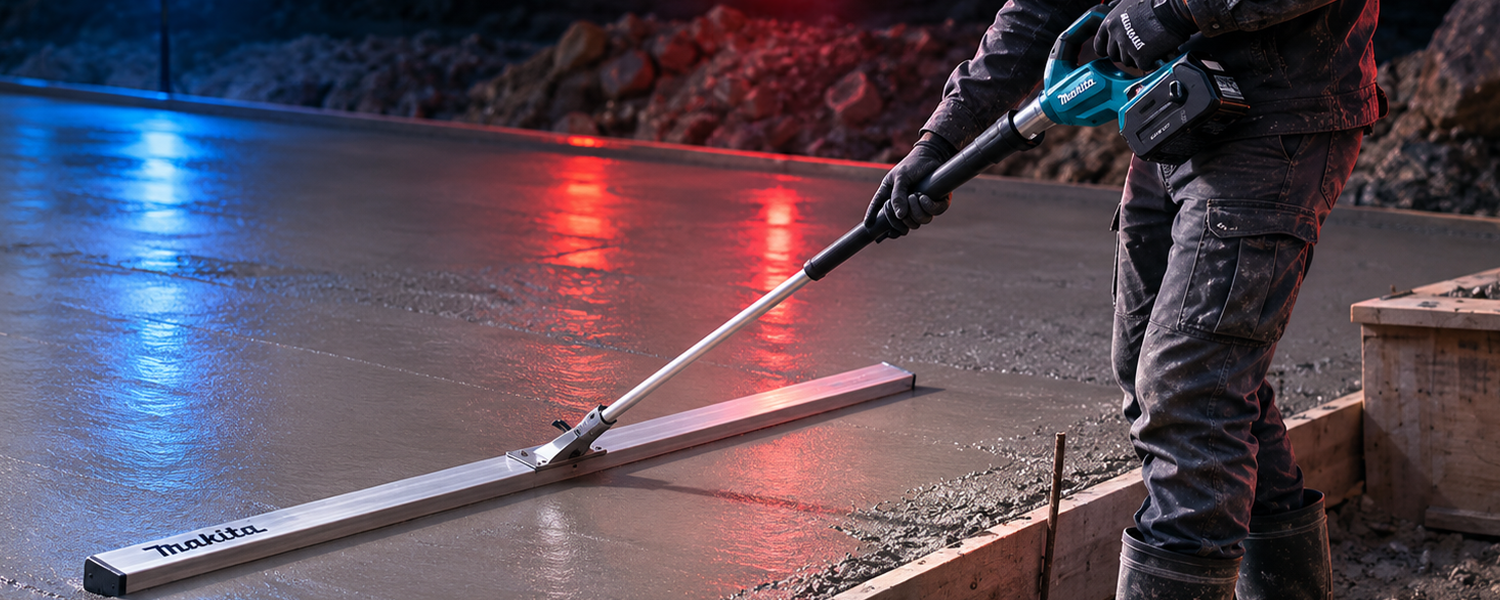
Vibrating screed / surface vibrator: After the concrete has been deaerated with the poker vibrator and roughly struck off with a concrete rake or screed bar, deploy a mechanical vibrating screed. The vibrating aluminum profile (typically 1.5 to 3 meters wide) glides over the wet concrete. The vibrations drive excess air from the top layer, immediately seal pores, and effortlessly level uneven spots in a single smooth pass.
Rebar tier (Makita DTR180 / DTR181, 18V LXT): Solid preparation prevents shifting during the pour. With this automatic tying tool, you tie crossing rebar in less than a second. This ensures that mesh panels do not shift or come loose under the weight of falling concrete and the vibrations of the poker.
Finishing tools (Hand trowel, bull float & broom): After the vibrating screed, the surface is smoothed with a bull float fitted with an extendable handle. Once the concrete starts to set, it can be power-troweled or given a broom finish for slip resistance.
Step-by-step guide: pouring and finishing wet concrete in five steps
Follow this established workflow to make optimal use of working time and prevent cracking or honeycombing:
Step 1: prepare formwork, vapor barrier, and reinforcement
Check that the formwork is watertight and rigidly braced. Lay plastic sheeting on the subbase to prevent mix water from draining too quickly into the ground. Position reinforcement mesh on bar chairs or spacers (minimum 30 to 50 mm concrete cover) and tie the intersections securely using the Makita DTR180 rebar tier.
Step 2: pour and roughly distribute wet concrete
Pour the concrete evenly from the mixer chute or concrete pump. Distribute the mix using concrete shovels or concrete rakes (placers). Avoid large heaps: work in sections and place the concrete as close to the final slab thickness as possible to minimize excessive lateral moving.
Step 3: internal compaction with the concrete poker vibrator
Insert the poker vibrator vertically into the poured concrete, penetrating slightly into the underlying layer (if pouring in lifts). Hold the poker stationary for 5 to 15 seconds until large air bubbles stop surfacing and a glistening sheen of cement paste appears. Withdraw the poker slowly with small up-and-down movements so the hole closes immediately.
Maintain an insertion spacing of approximately 8 to 10 times the head diameter (roughly 20 to 30 cm apart). Avoid prolonged contact between the poker and reinforcement to prevent voids from forming around the rebar.
Step 4: screeding and surface compaction with the vibrating screed
Place the aluminum blade of the vibrating screed on the surface. Start the vibration drive and pull the screed backward at a steady walking pace over the fresh concrete. The vibration causes the aggregate to settle just beneath the surface and instantly brings the floor to a clean, homogeneous grade. Work in overlapping passes of approximately 15 to 20 cm.
Step 5: edging, power floating, and curing
Touch up edges and corners with a magnesium hand float. If a super-smooth finish is desired, power float and trowel the floor once it can support foot traffic (footprint depth approximately 3 to 5 mm). Cover the floor immediately after initial set with vapor-tight curing sheets or apply a curing compound to prevent plastic shrinkage cracking caused by premature drying.
Overview of concrete pouring and finishing equipment
The table below shows the necessary equipment for pouring, compacting, and finishing wet concrete:
| Model / Machine | Category | Power or voltage | Capacity or dimensions | Key practical function |
|---|---|---|---|---|
| Makita DVR450 | Cordless concrete vibrator (18V LXT) | 18V Li-Ion | 1,200 mm shaft / Ø 25 mm head | 13,000 vpm; compacting wet concrete and deaerating slabs up to 20 cm thick. |
| Makita DVR850 | Cordless concrete vibrator (18V LXT) | 18V Li-Ion | 2,400 mm shaft / Ø 25 mm head | Extended reach for strip footings, deep formwork, and floor sections. |
| Makita VR001G | Cordless concrete vibrator (40V Max XGT) | 36V – 40V Max | Ø 32 to 38 mm poker heads | High impact power and adjustable speeds for large volumes and stiff mixes. |
| Vibrating screed (surface vibrator) | Surface compactor / screed | Petrol or cordless battery drive | Working width: 1.5 to 3.0 m | Levels, drives air from the surface layer, and strikes concrete off to precise grade. |
| Makita DTR180 | Cordless rebar tier (18V LXT) | 18V Li-Ion | D10 x D10 to D16 x D16 | Rapid tying of reinforcement mesh in preparation for pouring. |
| Makita PC5010C | Concrete planer (230V) | 1,400 W | Ø 125 mm disc | For post-cure smoothing of cold joints and high spots. |
Common mistakes when pouring wet concrete
Prevent structural weaknesses and loss of quality by avoiding these common pitfalls:
- Dragging the poker vibrator horizontally through concrete: Never drag a poker vibrator horizontally through the mix to move concrete. This causes severe segregation and leaves a trail of entrapped air pockets.
- Over-vibrating the mix: Vibrating too long in one spot causes coarse aggregate to sink and bleed water to rise. Stop as soon as the surface has a glossy sheen and large air bubbles cease escaping.
- Leaving the vibrating screed stationary: Never let a vibrating screed run in one stationary position on wet concrete. The screed will sink immediately, creating deep depressions that are difficult to repair.
- Pressing the poker against formwork or rebar: Avoid direct contact with formwork walls or rebar; this causes aggregate shadow lines on finished surfaces and creates voids along the steel.
- Delaying curing procedures: As soon as the surface loses its sheen and turns matte, moisture loss must be prevented. Without curing compound or plastic sheeting, water evaporates too rapidly, causing immediate plastic shrinkage cracks.
The result
By combining a powerful concrete poker vibrator for deep compaction with a vibrating screed for the surface, you achieve a dense, ultra-strong concrete floor free of honeycombing and voids. The surface is evenly profiled, providing the ideal foundation for power troweling, broom finishing, or applying a subsequent screed layer.
Frequently asked questions about wet concrete
How deep and how long should you insert a concrete vibrator into wet concrete?
Always insert the poker vibrator completely vertically until the head is fully submerged (and roughly 10 cm into any underlying previous lift). Keep the vibrator stationary for 5 to 15 seconds on average until the surface starts to glisten and large air bubbles stop emerging. Then withdraw it steadily.
Why is a vibrating screed better than manual screeding?
A manual screed board requires immense physical effort and only levels the surface. A vibrating screed combines strike-off with high-frequency surface vibration. This consolidates the mix more thoroughly, compacts the top layer up to 10 cm deep, expels entrapped air, and brings a smooth cement paste to the surface.
What is the radius of action of a 25 mm concrete poker vibrator?
A 25 mm poker head (such as on the Makita DVR450) has an effective radius of action of approximately 15 to 20 cm around the vibrating head. To ensure comprehensive compaction, maintain an insertion spacing of around 20 to 25 cm so that the zones of influence overlap generously.
When should you start using the vibrating screed after pouring?
As soon as the concrete is poured, roughly struck off to level, and compacted with the poker vibrator, immediately follow up with the vibrating screed. This must be carried out while the concrete is still liquid and plastic, before initial set begins.