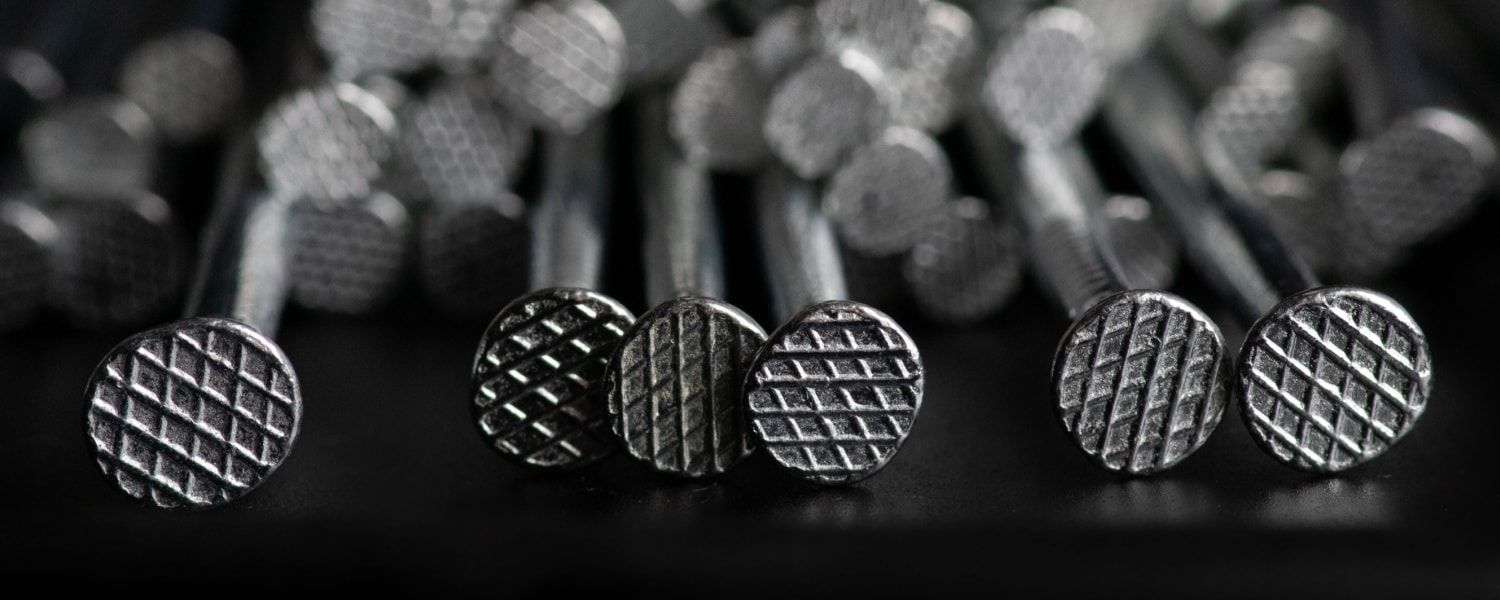
Nails are almost as old as mankind. Bronze nails have been found that date from about 4,000 years before the beginning of our era. Thus, nails have long been considered extremely valuable and necessary. In the Middle Ages, they were even traded as an informal currency. Nails have been forged by hand for millennia. It was not until the nineteenth century that wrought iron was replaced by the wire nail, the nails we use today. Wire nails are made by pulling coils of steel wire through dies until they reach the desired diameter, after which they are cut into short bars and formed into nails. Most nails are galvanized or made of stainless steel, but there are also decorative brass nails, for example.
Types of nails
- Flat tack. When you hear the word nail, a flat tack is what you immediately think about, and it is the most commonly used one for wood joints. The flat head provides an extra strong connection, but since it remains visible, it can be annoying and result in a messy look.
- Lost tack. Lost tacks — nails without a head — are perfect for cleaner work without visible nails. You can hammer a lost tack all the way into the wood. Tap a little further into the wood with a punch, fill the hole, and voila! There is nothing left to see.
- Concrete nail. This nail made of extra hardened steel is ribbed to adhere better. There is also a version without ribbing — a steel nail.
- Drywall nail. Especially used in soft materials such as plaster, this nail has ridges for better adhesion.
- Aerated concrete nail. Similar to the drywall nail, used in softer materials and with ridges for better adhesion.
- Corrugated sheet nail. As the name suggests, this nail is used for fixing corrugated iron. It has a cap to prevent leakage. Because corrugated sheets are always attached via the highest point of the corrugation, this nail is also very long.
- Aqualine nail. The extra long version of the corrugated sheet nail for use in the thickest beams.
- Anchor nail. This nail has a twisted shank, which makes it work like a screw, ensuring an extra strong connection. Anchor nails are used, for example, to fix construction anchors.
- Clog nail. The nail for furniture upholsterers. It has a wide head that you can’t hit through the canvas.
- Asphalt nail. The short length and extra large head make this nail suitable for securing bitumen and asphalt paper.
- Construction site nail. This nail is commonly used in the application of insulation blankets. The plate behind the head prevents you from hammering it through the insulation material.
- Staple. A staple is a nail with two points, mainly used to attach wire mesh and wire to wooden posts.
Different ways to nail
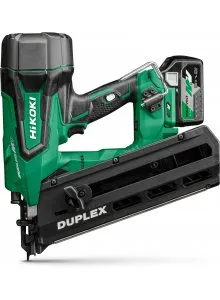
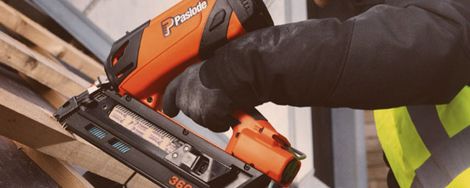
The most obvious way is by hand. But you can also automate the process, for example, with a battery nailer that shoots a nail into the material every second.