Rising moisture
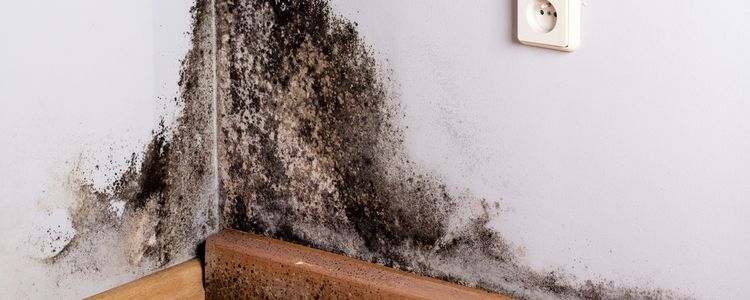
Moisture spots on the underside of the walls indicate rising damp. Due to an old foundation or the lack of a damp-proof course, groundwater can build up in the walls.
Do-it-yourself solution
The way to solve this problem is to stop the ingress of capillary water. You do this by injecting a water-repellent agent – usually a siloxane gel – into the wall through drill holes.
Required tools
- Drilling machine
- Caulking gun
- Tape measure
- Vacuum cleaner
This is how you proceed
- Determine where the water barrier should be and drill holes at the level of the first brick. Use a 12 mm drill and drill the holes slightly downwards at a distance of 10 cm. The holes must be almost as deep as the wall is thick. You can mark the desired depth with a piece of tape around the drill.
- Remove the grit from the drill holes with the vacuum cleaner and inject the water repellent gel with a caulking gun.
- Cover the drill holes with a mortar and wait at least a month before you paint over the wall.
Penetrating moisture
Weathered, porous exterior walls can be the cause of penetrating damp, especially on the side where most rain falls.
Do-it-yourself solution
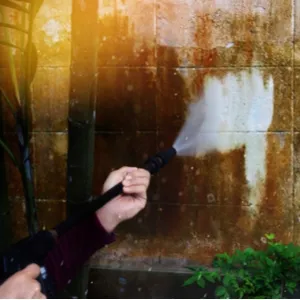
Impregnating the façade with a suitable impregnating liquid – depending on the wall material – provides a water-repellent layer that prevents rain leaking through.
Required tools
- High-pressure cleaner
- Ladder
- Nebulizer
- Protective clothing
- Protective clothing
This is how you proceed
- Clean the facade with a high-pressure cleaner.
- Repair damage to the brickwork and joints.
- Protect doors and windows with a cover film.
- Spray the impregnating agent evenly onto the facade. Work from top to bottom and only stop when the wall is saturated with the liquid.
Leakage
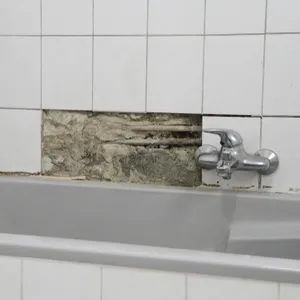
A leaking water pipe or drain pipe often betrays itself through a circle on the wall or in the ceiling.
This does not mean that the leak is in this place, because the moisture can move through the wall and come to the surface somewhere else.
An inexplicably higher water bill can also be an indication of a leak. There is nothing else to do than to detect the leak and to remedy the cause.
Condensation moisture
This moisture problem is not due to structural defects and is often easy to solve yourself. Fogged windows and damp walls are indications of condensation, and the problem mainly occurs in wet areas such as kitchen and bathroom and in well-insulated homes.
Do-it-yourself solutions
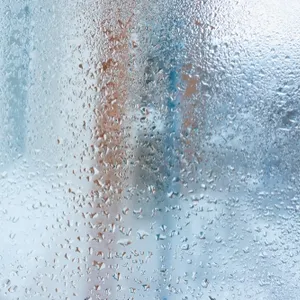
The way to solve this problem is to reduce the air humidity level.
- Ensure adequate ventilation. Opening a window or door more often helps, as does the installation of ventilation grilles. In case of persistent condensation problems, it may be necessary to install a mechanical ventilation system.
- A cooker hood is a solution for air humidity in the kitchen.
- Do not hang the laundry inside to dry.
- If a condensation problem occurs in a small space, a moisture eater can come in handy, although this does not resolve the cause.
Construction moisture
A lot of water is used in construction, and it can take years for a new house to dry completely. Building moisture can, among other things, lead to peeling plaster, mold and a musty smell. There is not much you can do about it except good ventilation and being patient until the problem resolves itself.