A brick wall as a border for a terrace or a flower bed, or finished as a bench, is a beautiful, natural element in the garden. Bricklaying is not the easiest job.
If you want to do it properly, a lot of materials and tools are involved. If you have never built brickwork, such a decorative low garden wall is a great project to start mastering the skill.
You will need
Tools
- Masonry cord
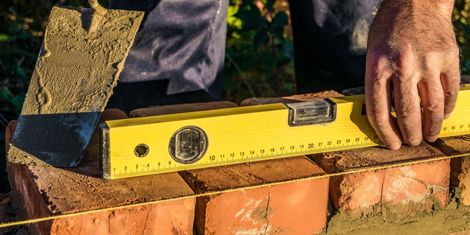
- Spirit level
- Trowel
- Spade
- Mixing paddle
- Tape measure
- Mortar tub
Materials
- Foundation concrete, ready-made or self made with cement, coarse sand and gravel
- Masonry mortar, composed of sand and cement
- Joint mortar
- Concrete irons
- Aluminum profiles or perpendicular beams
- Slats
Single-leaf or brick thick?

There are two ways to build a brick wall. In professional language: two bonds. With a single-leaf wall, the bricks are placed on top of each other in the longitudinal direction.
The thickness of the wall is then half a brick. For a brick thick wall, you alternately place a layer of bricks across and two bricks in the length.
Single-leaf masonry is mainly used for the outer wall in cavity walls. In many cases, brick-thick will be the preferred method for a garden wall.
How to build a brick garden wall in 4 steps
1. Apply the foundation
- Dig a trench over the entire length of the wall. About 50 cm deep is usually enough to reach a solid surface. Make the trench twice as wide as the thickness of the wall.
- Lay two concrete bars in the longitudinal direction of the wall and support them with bricks. Connect them every half meter with short pieces of reinforcing steel that you secure with iron wire.
- Prepare the concrete (1 part cement on 2 parts coarse sand and 3 parts gravel) or use ready-made concrete.
- Fill the trench with concrete. Allow to dry for a few days before you start bricklaying.
2. Prepare the masonry
- Calculate how many bricks and mortar you need. You’ll use an average of 20l of mortar per square meter of masonry. Mortar is for sale ready-made, or you can make it yourself by mixing 1 part cement with 5 parts sand
- Set up profiles on the ends of the wall. You can use aluminum profiles or straight beams for this.
- Secure the profiles securely with 2 slats, at an angle of 90 °.
3. Bricklaying
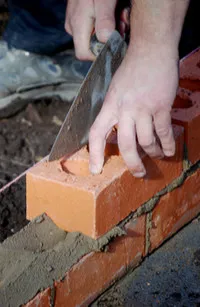
- Tension the masonry cord between the profiles at the top of the first layer of stones and check whether it is level.
- Apply a substantial layer of mortar to the foundation and press the first brick into the mortar.
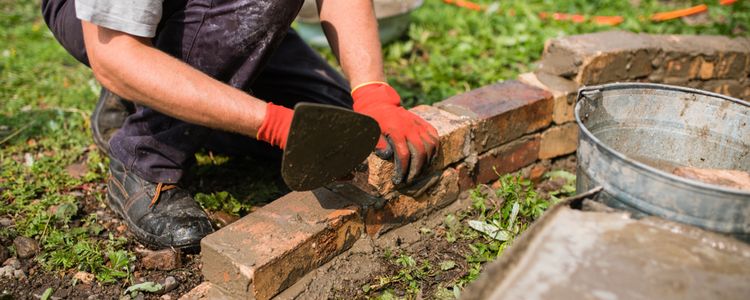
- Spread the mortar on the side of the brick and tap the next brick into place with a trowel.
- Proceed in the same way for the following layers, making sure that the joints are staggered in a regular pattern. Tip: for a nice effect, make the vertical joint slightly narrower than the horizontal.
- Always adjust your masonry cord to the next layer and keep checking whether you are still working level.
- Always scrape away the excess mortar before it can harden.
4. Joints and further finishing

- With a garden wall it is important that the top layer is watertight. You can achieve this with a top layer of tilted stones, so that the rainwater runs off. Another option is to finish the wall with a covering stone, such as blue limestone.
- Scratch the joints with a nail.
- Apply the joint mortar, let it dry and brush the wall well.
DIY Bricklaying, here’s how you do it
Bricklaying is an art that mainly comes down to experience, we said. In this short video you can see an experienced bricklayer at work. Inspirational. Watch it if you want to build your own garden wall with bricks. A real lesson breaklaying for beginners from a local craftsman.